

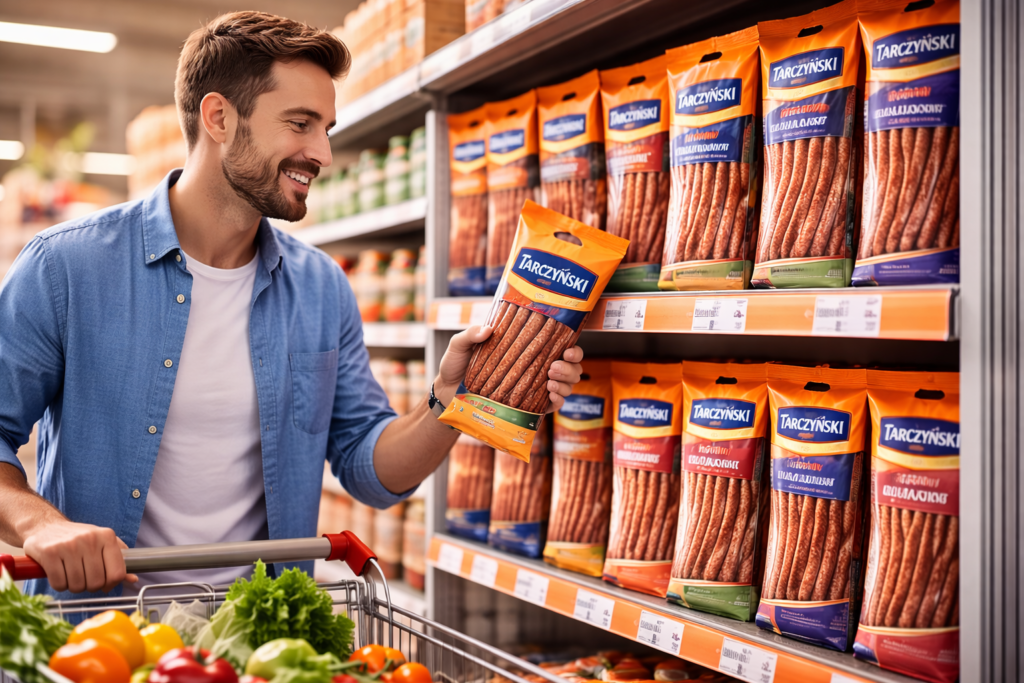
I have a habit when I travel. While most people are looking at landmarks, I’m looking at supermarket shelves.
I want to know what people buy without thinking. What they grab when they’re hungry, in a rush, half-awake, or with a crying kid in the trolley. Those are the products that tell you something real about a business.
That’s how I ended up investing in a Polish sausage company.
Every time I spent time in Poland, I noticed the same thing. At petrol stations, in convenience stores, in tiny kiosks, people kept buying these small packs of kabanos — thin, dried sausages in bright packaging you couldn’t miss. The brand that kept popping up was Tarczyński.
It wasn’t positioned like some premium delicacy. It was just there. Everywhere. Cheap enough to not think about. Familiar enough to trust. Convenient enough to grab automatically.
That’s exactly the type of behaviour I look for. Not “this product is amazing”. More like: this product is habitual.
A habitual purchase is an investor’s best friend.
Then I looked at the numbers
Once I get interested in the product, I go to the financials. This is where things got slightly ridiculous.
When I first invested, the company was trading on a P/E ratio of around 3.
Three.
That’s the kind of number you expect from a business in terminal decline, a lawsuit factory, or something about to fall off a cliff. Not a company with growing distribution, strong branding, and visible consumer demand.
Then I looked at the revenue and net income trend. They were doing exactly what you want to see: growing steadily year after year. Not explosive tech-style growth, but consistent, reliable expansion. The sort of growth that compounds quietly while nobody pays attention.
At the same time, the broader Polish economy was still expanding. Rising wages, rising consumption, a growing middle class. If you sell affordable branded food into that environment, you don’t need genius-level strategy. You just need to execute competently and stay on shelves.
So I had:
- A habitual consumer product
- A visible brand
- Growing revenue
- Growing net income
- A supportive macro backdrop
- And a valuation that suggested the market had simply… not noticed
That combination doesn’t come around often.
The vegan question
Of course, there was an obvious risk. If you’re investing in a meat snack company today, you have to confront the vegan trend.
So I did what I always do: I asked who the actual customer is. The core buyer here isn’t a hyper-urban plant-based demographic. It’s mass-market consumers buying convenient protein snacks. Builders, drivers, students, families. In Poland and among Polish communities abroad, meat snacks are culturally normal.
That doesn’t make the vegan shift irrelevant. But it does change the magnitude of the threat.
Then the company did exactly what you want to see from a good consumer business. They launched a vegan kabanos. Same format, same branding logic, just expanded for a new consumer.
That told me management wasn’t asleep. They were adapting without abandoning the core.
Alongside that came steady small innovations: spicy versions, grab bags, protein positioning, new formats. Nothing revolutionary. Just constant iteration. The kind that keeps a brand alive in people’s daily routines.
The diaspora edge
Another factor I loved was the Polish diaspora. Millions of Polish consumers live across Europe. Many remain loyal to familiar brands from home.
When you sell a product like this into countries where those consumers earn stronger currencies, something interesting happens. The product feels cheap in local terms, so people don’t overthink the purchase. It remains habitual. Meanwhile, the company benefits from selling into higher-income markets.
And once the product is on shelves abroad, non-Polish consumers start trying it too. Curiosity turns into habit surprisingly quickly when the product is convenient and affordable.
That creates a long runway for growth beyond Poland itself.
The part investors care about: what happened next
I bought the shares at around 16 złoty.
For about a year, nothing dramatic happened. Which is usually what happens with good investments. They sit there. Quietly. While the business continues doing what it does.
Then the market woke up.
The combination of earnings growth, expansion, and the absurd starting valuation couldn’t stay ignored forever. The share price didn’t just drift upward. It exploded.
From around 16 złoty, it eventually ran to over 100 złoty per share.
Now, of course, stories like that always sound neat in hindsight. At the time, it just felt like buying a cheap, growing consumer business and waiting. There was no grand prediction about a sixfold move. The thesis was simply that a company with those characteristics shouldn’t be trading on a P/E of 3.
Sometimes investing really is that straightforward.
What I learned
This investment reinforced something I’ve believed for a long time. You don’t always need complex models or exotic sectors. Sometimes the best opportunities are hiding in plain sight, in products people buy every single day.
I saw:
- A habitual consumer product
- Strong brand recognition
- Consistent revenue and profit growth
- A growing domestic economy
- Diaspora-driven expansion
- Management willing to adapt (vegan launch, new formats)
- And a valuation that made no sense
That’s the kind of setup I look for again and again.
Not because every investment will go from 16 to 100 złoty. They won’t. But because when you combine a real-world consumer insight with disciplined valuation, you give yourself a chance to catch the rare ones that do.
Sometimes the signal isn’t in a complicated spreadsheet.
Sometimes it’s in a petrol station fridge, a crowded convenience store, and a product people keep buying without ever stopping to think about it.